

England U18s: Sep-Oct 2026 international window
Updated: Nov 1
England men’s under-18s competed in the UEFA Friendship Cup during the September-October 2026 international window, playing four matches in total, including three group-stage games and the final.
After watching every minute of action, this post:
Match Roundups
Here are very brief roundups of England U18s four fixtures, including starting line-ups, substitutions, goalscorers, and opposition playstyle snapshots and namechecks.
Group Match 1: England 3-2 Colombia (watch full match)

Starting Line-Ups: See above. England in white.
England Subs:
64 mins:
12 Wain on for 3
15 De Lisle on for 8
20 Alabi on for 6
76 mins:
19 Offiah on for 9
17 Tavares on for 14
18 Alker on for 10
21 Smith on for 4
Goals:
England: Mills (12'), Greenwood (45', 54')
Colombia: Caicedo (30'), Miguel Agarnez (75')
Opposition:
Playstyle Snapshot: 1st Half mid-block and counterattack. 2nd Half applied higher pressure. This, coupled with England's lower confrontation line, resulted in more Colombia possession and therefore control, but mainly led to shot quantity > quality.
Namechecks:
19 M. Caicedo: Prepared to shoot on sight, as demonstrated with goal (which match footage annoyingly didn't capture in full). Consistently made runs in behind.
20 E. Carrillo: Anchored midfield. Impressive on-ball actions in 2nd Half. Highlight being his disguised assist for Colombia's second goal.
Match Report: Read England Football's match report
Group Match 2: Egypt 1-2 England (watch full match)

Starting Line-Ups: See above. England in white.
England Subs:
65 mins:
16 Sambou on for 12
8 Little on for 15
9 Greenwood on for 19
11 Thompson on for 14
77 mins:
3 Diakite on for 5
4 Lawrie on for 21
10 Farkas on for 18
20 Alabi on for 6
14 Mills on for 7
Goals:
England: Kavuma-McQueen (14'), Mills (82')
Egypt: Abdelaziz Mousa (78')
Opposition:
Playstyle Snapshot: Mid-block and counterattack. Threatened throughout but Wyscout 3.41 xG skewed as Egypt goal was a second rebound, following a couple of close-range saves and blocks. Limited possession but faced limited threat to their own goal.
Namechecks:
7 M. Gamal: Played RW and then LB. From both positions he played some pinpoint, long range passes with his favoured left foot.
Match Report: Read England Football's match report
Group Match 3: Korea Republic 1-2 England (watch full match)

Starting Line-Ups: See above. England in white.
England Subs:
46 mins:
15 De Lisle on for 8
60 mins:
7 Kavuma-McQueen on for 14
18 Alker on for 10
12 Wain on for 3
19 Offiah on for 9
21 Smith on for 23
72 mins:
17 Tavares on for 11
4 Lawrie on for 16
Goals:
England: Alabi (57'), Kavuma-McQueen (91')
Korea: Ian (70')
Opposition:
Playstyle Snapshot: Mid-block and counterattack. Wasted a number of promising attacking transitions with shots from distance. England dominated possession but Korea created more and better chances. Denied two definite goals following a last-ditch interception and GK 1v1 save.
Match Report: Read England Football's match report
Final: England 0-2 Spain (watch full match)

Starting Line-Ups: See above. England in red.
England Subs:
60 mins:
8 Little on for 6
69 mins:
12 Wain on for 3
17 Tavares on for 11
92 mins:
10 Farkas on for 15
Goals:
Spain: Zamorano (40'), Cruz (98)
Opposition:
Playstyle Snapshot: Classic Spain 4-3-3 in possession. Played through the 3rds, central rotations and overloads, high and wide wingers whose 1v1 ability created chances. Attempted to press high but often forced into a mid-block. While England controlled for large periods, both in and out of possession, Spain were more productive, getting the ball into more dangerous areas and creating higher quality chances.
Namechecks: Slightly biased, as watched all during U17 Euros
11 C. Imga: Continued to impress with his 1v1 ability. Attacks inside and outside. Lack of end product in this match but a consistent threat.
5 J. Domínguez: Guilty of a few ball losses from passes and carries but displayed quality in possession too. Provided effective defensive cover in channels.
3 J. Pesquer: Did not standout during U17 Euros but performed well vs England, both in and out of possession. Retained and carried under pressure. Supported attacks. Won a number of 1v1 defensive duels.
Match Report: Read England Football's match report
Key Tactical Principles & Mechanisms
In terms of overarching identity, throughout the tournament, regardless of opposition, personnel or game state, England consistently aimed to control matches by dominating possession, recording higher possession shares in all four games: 58% vs Colombia, 68% vs Egypt, 63% vs Korea, 56% vs Spain.
Two defining features of England's approach were structured build-up and organised high pressure, with both working hand-in-hand to support the team's overall objective.
In terms of England's organised high pressure (which is not covered in detail in this post), the underpinning principle was Force Wide, Apply Pressure, with the mechanisms used to implement this including: played-orientated roles in central midfield, fullback jumps and far-side coverage.
Counter-pressing and recycling play, both in possession and following regains, were other recurring themes and tactics used to assert control in games. The latter tendency enabled England to frequently reinitiate their build-up phase, resetting both teams' structures in the process and imposing the conditions they wanted to play in.
In this section, we'll specifically explore the following key attacking principle and the mechanisms England U18s used to implement it:
Progress Through, Attack Wide
Centre-Back playmakers
Midfield rotations
High-tempo central combinations
Inside-channel runs in behind
Wingers' creative onus
Progress Through, Attack Wide
England's build-up centered around their 4-3-3 base in-possession structure, which comprised multiple triangle connections (units). See tactical illustration below for a visualisation, including typical player movements. In addition to these movements, players within the midfield and wide triangles also interchanged positions.

(For reference, triangle connections are also a fundamental aspect of the men's senior team under Thomas Tuchel. To read more about this, I'd highly recommend the brilliant Tactx who have covered it, and the tactical concept in general, extensively across their platform.)
In the simplest terms, England aimed to progress possession and create chances by playing through the thirds, with repeated tendencies evident across different attacking phases. For reference, England primarily faced high- and mid-blocks, with high-pressure spells most commonly occurring at England goal kicks and open play deep-up. While Spain predominantly defended in a 4-4-2, Colombia, Egypt and Korea used a variation of systems, ranging from 4-4-2, 4-2-3-1, 4-4-1-1, with one consistency being matching up man-to-man in central midfield.

The base unit, comprising the two centre-backs and DM (single-pivot), was instrumental in dictating England's build-up play. This trio, alongside the supporting fullbacks and dropping midfielders (RCM and LCM), demonstrated patience, circulating possession in their own third and half, depending on the height of the opposition's engagement (e.g. a high or mid-block). Short backwards, sideways and link passes were frequent occurrences, with players also holding onto the ball to draw opposition pressure before releasing to a free teammate.
The intention in this phase was to establish control of the ball (and, in their view, the match), while also attracting and manipulating the opposition's first lines of pressure to create opportunities to progress centrally through the opposition's defensive lines. It was evident that the players' intentions were collectively aligned, with the preference of playing through the opposition, as opposed to around or over.
Interestingly, the majority of England's progressive actions (line-break passes and carries) came from their centre-backs, with each player selected to play this position performing this role for the team during build-up. While being forward-facing will be a factor, it also suited the abilities of England's most used centre-backs and pairing: Freddie Lawrie and Marlow Barrett.

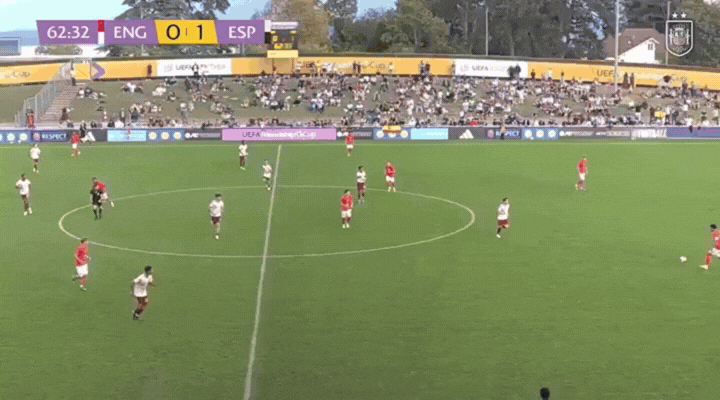
This collective intention to play through, understandably, occurred mostly in central areas of the midfield third, where England repeatedly increased the tempo of their play to create opportunities to progress through the opposition's forward and midfield lines. Frequent counter-movements, interchanges and mobility within their central midfield structure were a consistent feature, in an attempt to create a constant variation of (and opportunity for) numerical, positional and dynamic advantages. Plus, create separation from the opponent's man-to-man in central midfield.
Some recurring outcomes of this dynamic midfield were creating direct passing lanes into the RCM and LCM between the opposition midfield and defensive lines, as well as quick passing combinations between close-proximity teammates. The most common of these were Up, Back, Throughs, with the centre-forward often involved after dropping short to receive to feet.
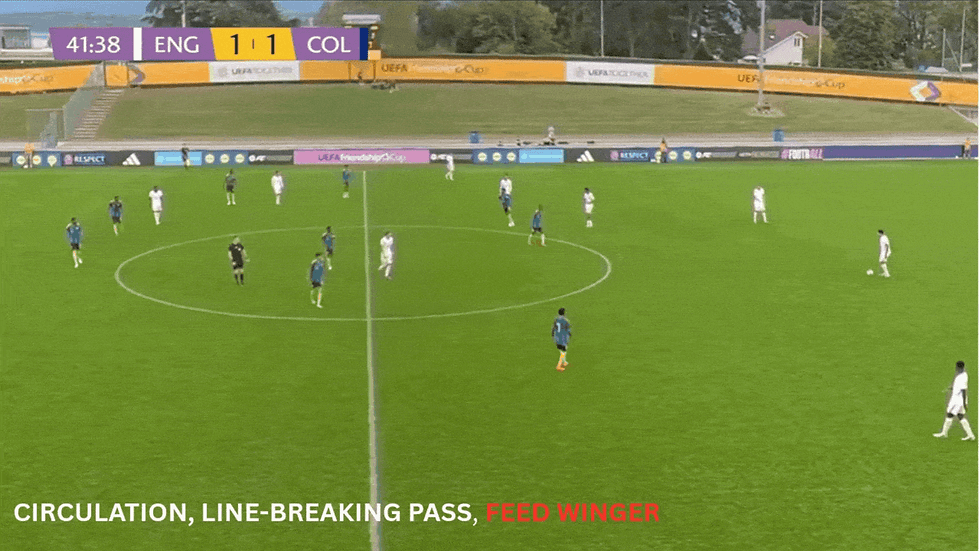

Of course, England did not always look to, or need to, play through the opposition to progress into the final 3rd. During spells of settled possession in the middle third, with the opponent sat in a narrow mid-to-low-block, England's backline (typically their centre-backs), positioned around the halfway-line, had direct access to the wingers, who were positioned wide in the final 3rd, through passes around the opposition's defensive block.
Following successful progression through the opposition's midfield line, England almost always looked to quickly feed their wingers in the final 3rd. Generating attacks from wide areas was another example of the players' collective alignment in their attacking intentions.
England's wingers carried the main responsibility for chance creation, often through individual actions such as 1v1 attacks (inside and outside), diagonal dribbles, and cutting inside to combine and/or shoot. While each winger tended to perform all of these actions, their individual tendencies influenced both the frequency and effectiveness.
One way England supported their wingers in the final 3rd, while also providing a slightly varied wide attacking threat, was through inside-channels runs in behind the opposition backline, specifically between the opposition fullback and centre-back. These forward runs intended to stretch play, offering a passing option in behind the defensive line, typically into the 'assist zone' inside the box, while also taking opponents away and creating space for the wingers to cut inside.


Finally, in this telestrated clip, taken from the Colombia game, a number of England's attacking principles, mechanisms and tendencies are displayed within one prolonged possession spell.
To wrap up this section, it is worthing highlighting that England's in-possession phases were consistently effective in progressing the ball through opponents and into the final 3rd. However, this territorial gain did not consistently correlate into creating high volume or quality chances.
Some of the perceived recurring issues were:
Winger Reliance: While each winger showcased their talent during the tournament, there was also (understandably) a degree of inconsistency in the quality of their final actions.
Predictability: As described within this section, England's attacking play had a repeatability factor. From an England perspective, this provided advantages in terms of collective alignment, however, from an opposition perspective, it (at times) made it easier to anticipate and defend. Opponents dropping into low blocks and limiting space in the final 3rd (especially for wingers) was a familiar sight.
Possession Losses: Due to England's preference of playing through the opposition and using quick, often one-touch, passing combinations, there was an increased probability of possession losses in central areas which frequently resulted in defensive transitions.
Build-Up Focus: With a number of England players dropping to provide support in build-up phases, namely the RCM, LCM and at times CF, England sometimes lacked immediate box presence.
Lacked Threat In-Behind: England could have benefitted from varying their attacking play at times using more runs in-behind the opposition defensive line during build-up phases. Specifically, from their CF (opposite runs) and Wingers (out-to-in runs) when their CBs had uncontested possession. The majority of their threat in-behind came in wide areas which added to their relative attacking predictability.
Player Snapshots
This section details snapshot observations on every England U18 player who featured during this international window, starting with the squad list, positions and (circa) minutes played.
# | Name | Positions Played | Minutes* |
1 | Roman Dowell | GK | 180 |
13 | Ben Vickery | GK | 180 |
2 | Oscar Sandiford | RB | 270 |
12 | Jake Wain | LB / RB | 140 |
16 | Gabriel Sambou | RB / RCB | 100 |
4 | Freddie Lawrie | RCB | 210 |
5 | Marlow Barrett | LCB | 260 |
21 | Reon Smith | RCB / LCB | 110 |
3 | Calvin Diakite | LB / LCB | 210 |
23 | Oliver Wilkinson | LB / LCB | 150 |
6 | Tyrese Noubissie | DM | 190 |
20 | Sam Alabi | DM | 130 |
10 | Erik Farkas | RCM | 150 |
18 | Samuel Alker | RCM / LCM / DM | 210 |
15 | Hugo De Lisle | LCM / RCM | 230 |
8 | Max Little | LCM | 170 |
11 | Kyran Thompson | RW / LW | 250 |
7 | Ryan Kavuma-McQueen | RW / LW | 200 |
14 | Michael Mills | LW | 150 |
17 | Ajay Tavares | LW | 130 |
9 | Jashayde Mensah-Greenwood | CF | 260 |
19 | Phoenix Offiah | CF | 110 |
If viewing on mobile, scroll right to view positions and minutes columns.
*Minutes are i) circa and ii) rounded up to the nearest 10. It is also worth noting that UEFA stipulated that every player in the squad must play at least 90 minutes over the course of the tournament.
Before delving into the individual player observations, it is worth noting that England essentially used the same system in every game, both in and out of possession, with each role within the team requiring players to perform specific actions.
This was applicable across all positions: goalkeepers, fullbacks, centre-backs, midfielders, wingers and strikers. To reduce repetition, players have therefore been categorised by positions played, with the actions specific to each role, and performed by all players within the group, detailed upfront.
GOALKEEPERS
Due to England's in possession approach, each goalkeeper was heavily utilised in deep build-up, typically playing short ground passes to split CBs, both from goal kicks and as a third centre-back in open play. While invariably in an overload scenario, each GK demonstrated instances of composure and confidence on the ball even when under pressure.
In terms of more individualised observations and traits:
1 Roman Dowell: Effectively protected behind the defensive line when required, coming off his line on a few occasions to collect and deal with balls over the top. Against Korea, he made one impressive reflex save when 1v1, plus a quick recovery to swarm an attacker's feet after his ball loss led to an opposition counterattack and box entry. Committed to playing out despite making a few errors, namely a ball loss late-on versus Colombia, where he attempted a very risky pass (and unnecessary IMO) through two nearby opponents inside his own box (risk > upside), and several losses versus Korea, where he was guilty of overplaying at times, again with minimal upside in those specific situations.
13 Ben Vickery: Against Egypt, he made two impressive reflex saves from close-range. The first, a save down low to deny a header, palming wide too, following the second phase of a corner. The second, a near post save while backpedaling, clawing back a well-struck shot before the unavoidable rebound was bundled in for Egypt's goal.
Future viewings: Pay more specific attention to their goalkeeping fundamentals, although not an area of personal expertise. Additionally, it would be worthwhile observing against a high pressing opponent, as England mainly faced mid-blocks during this tournament, meaning both of their on-ball actions were relatively unopposed for the most part.
FULLBACKS
The most common actions performed by all fullbacks included:
Providing wide attacking support in the final 3rd, both below (recycle option and within counter-press proximity) and beyond (overlaps and underlaps) the ball. While all fullbacks consistently performed these roles, they were primarily used as decoys to occupy or takeaway opponents, creating space and options for the wingers to attack, who carried the main responsibility for chance creation.
During England's high-pressure phases, the fullbacks had a specific dual role: be ready to jump press the opposition fullback or remain connected with the backline to provide cover against long balls. While all fullbacks performed this role, one stood out in particular.
In terms of more individualised observations and traits:
2 Oscar Sandiford
Played all of his minutes at right-back. When he was utilised in the final 3rd, he delivered multiple one-touch crosses into dangerous areas inside the box.
Consistently (and visibly, see image below for an example of his body shape) switched on out-of-possession, especially during England's high-pressure phases. Applied aggressive and effective pressure in wide areas, either winning directly or forcing turnovers.

Won the majority of his defensive duels in Colombia and Korea games but faced his biggest defensive test against Spain, getting beaten 1v1 a few times but remained determined in his task. Showcased one instance of high acceleration during a recovery run to effectively defend a quick Spain long ball in behind. Also, witnessed a moment of him giving his RW verbals for not tracking back.
Future viewings: Pay more attention to defensive behaviours and decision-making.
3 Calvin Diakite
Played the vast majority of his minutes at LB, with a brief substitute cameo at LCB. Left-footed. Mixed bag of notes, as similar actions and traits produced both successful and unsucessful outcomes.
Positive observations included winning several duels and interceptions in the final 3rd due to his rest defence anticipation and positioning, sustaining attacking pressure. In attacking phases, he displayed good connections with each LW, varying his positioning and movement dependent on the winger's actions. This mainly included recognising when to advance high and wide following the winger's movement infield to offer a progressive passing option around the opposition block.
Negatives included too many instances of being careless in possession. He played a lot of passes inside and backwards to recycle play, which was a team intention, however, his body shape when receiving often made these actions i) predictable, leading to occasional ball losses and ii) difficult to adapt from, for example, if he wanted to play forward instead, the angle had already been blocked off. Defensively, he was beaten multiple times by Spain's RW in the final, and although a difficult opponent, he struggled to disrupt or provide much interference.
Future viewings: My initial takeaway is that Diakite performed better in more open-spaced direct, fast-attack sequences (playing off-the-cuff), as opposed to the circulate, bait and play-through approach, but more focussed viewings required to make a more informed assessment on his strengths and development areas, and in different contexts.
12 Jake Wain
Played right-back against Egypt, in his one start, and came on to play left-back in the other three fixtures. Right-footed. Providing attacking support in the final 3rd, whether playing on the right or left-side.
One individual tendency he showcased numerous times was an ability to break lines through carries, receiving wide in the middle 3rd before driving into available forward spaces, bypassing pressure and progressing the ball upfield. Against Egypt, his carries tended to be diagonal drives inside, whereas in other games, when playing LB, he drove on the outside.
Future viewings: Pay more attention to defensive behaviours and decision-making. Plus, watch in favoured position, presuming RB(?)
23 Oliver Wilkinson
Played LB against Egypt, and LCB against Korea. Left-footed. Minimal notes.
Against Egypt, he displayed a good understanding of the left-sided wide connection alongside the LW and LCM, with the trio interchanging and offering options below (recycle option), beside (wide or inside passing options) and beyond (overlaps and underlaps).
Against Korea, as playing centre-back, he was heavily involved in build-up, circulating possession and executing a number of progressive passes, typically around the opposition forward line to his fullback and winger.
Future viewings: Watch more to learn more, as limited minutes.
CENTRE-BACKS
Every England centre-back was heavily involved in and instrumental to build-up play, as detailed in the Key Tactical Principles and Mechanisms section. Observations are therefore skewed towards in-possession phases.
In terms of more individualised observations and traits:
4 Freddie Lawrie
Played RCB for all of his minutes. Right-footed, looked comfortable playing short with left.
Circulated possession along the backline and regularly broke opposition lines through passes and carries into advanced central areas. His progressive passes tended to be shorter and more vertical, bypassing the forward line to access central midfield, whereas his central carries were more ambitious, attempting to bypass midfield lines. However, these carries also increased the risk in defensive transition, as seen several times against Colombia.
Composed under pressure, consistently offered support angles, often backpedalling low and/or wide to create separation to receive and give himself passing angles. Occasional ball losses, and while an increased likelihood due to the role being asked to play, he was guilty in certain instances of trying to play when risk > upside.
Defensively, appeared measured, even when jumping out of the backline during England's high pressure phases, applying back pressure on dropping forwards but not overcommitting and leaving himself or team vulnerable. Made a number of interceptions in the backline, mainly from long balls, especially against Spain, perhaps an indicator of his defensive positioning and anticipation, but needs more of a focussed watch.
Future viewings: Pay closer attention to defensive behaviours and decision-making. Analyse in-possession actions in different contexts to make a more informed assessment on his strengths and development areas.
5 Marlow Barrett
Played LCB for all of his minutes. Left-footed, looked comfortable playing short with right.
Circulated possession along the backline and regularly broke opposition lines through passes into advanced central areas. Demonstrated a varied passing range, playing different distances (short and long), angles (vertical and diagonal), heights (ground and clipped), and often with deception. Impressive accuracy and weight of pass, both when playing through and around. See example of progressive passes in the GIF below (played at x1.5 speed).
Composed under pressure, consistently offered support angles, often backpedalling low and/or wide to create separation to receive and give himself passing angles. Like Lawrie, he was responsible for the occasional ball loss, which was an increased likelihood due to the role being asked to play, his instances were more execution-based, as opposed to decision-making.
Future viewings: Pay closer attention to defensive behaviours and decision-making. Analyse in-possession actions in different contexts to make a more informed assessment on his strengths and development areas.
21 Reon Smith
Played RCB during Colombia cameo and in his start against Egypt, and LCB when coming on against Korea. Right-footed. Minimal notes due to lack of minutes. Heavily involved in build-up against Egypt, circulating possession and executing a number of progressive passes through (vertical and diagonal) opposition forward lines into advanced central areas.
Defensively, noted two instances of covering depth against Egypt. On both occassions he demonstrated anticipation and readiness to run backwards (body shape) for the ball over the England RB and quickly shifted across to deal with the danger, firstly shepherding out of play and secondly blocking a low cross.
Future viewings: Watch more to learn more, as limited minutes.
16 Gabriel Sambou
Came on to play RB against Egypt and played RCB in his one start against Korea. Limited notes overall, as he played the fewest amount of minutes in the squad over the course of tournament.
Positive observations in the Korea game were his in-possession actions, as he was heavily involved in build-up. Executed a number of accurate and well-weighted vertical and diagonal line-breaking passes into the CF and midfielders between the lines. Opposition were in a mid-block so limited direct pressure but narrow passing lanes to play through.
Less positive notes were some questionnable defensive decisions and actions. Instances included i) a rash slide tackle attempt, taking himself out of the game, and leaving his backline in a 3v4 underload, ii) lack of cover and recovery speed during a Korea attacking transition, and iii) a lack of defensive anticipation, reaction and positioning in lead up to Korea's goal.
Future viewings: Too small of a sample size to make any initial assessment so watch more to learn more and also see if any of the above observations reoccur.
MIDFIELDERS
England operated with a midfield three, comprising a single pivot, referred to as the DM throughout this post. The DM was heavily involved in and instrumental to build-up play, as highlighted in the Key Tactical Principles and Mechanisms section, and typically supported advanced attacking phases below the ball, offering options to recycle and switch play, while equally being within close proximity to counter-press upon any loss of possession (rest defence position).
The RCM and LCM were involved in all phases of play, both in and out of possession. While their profiles varied, with some appearing more comfortable in deeper, advanced or box-to-box roles, they primarily operated up and down the pitch in the inside-channels. One of their key jobs was to exploit spaces between and within the opposition's midfield and defensive lines. They often acted as funnels, quickly connecting play from the backline to the wingers, taking minimal touches (and rarely making any alternate decisions) when receiving between the lines on the back-foot.
Additionally, as discussed in the Key Tactical Principles and Mechanisms section, there was lots of counter-movements, interchange and mobility within England's central midfield structure. All RCMs and LCMs consistently made runs in behind, specifically into the gaps between the opposition fullbacks and centre-backs, to offer a threat and passing option beyond, while also creating space for the wingers to cut inside.
In terms of more individualised observations and traits:
6 Tyrese Noubissie
Played DM for all of his minutes. Left-footed. Tournament disappointedly ended in injury on the hour-mark against Spain.
In possession phases he typically operated close to the centre-backs. Usually positioned behind the opposition forward line, offering to receive inside the defensive block, but was rarely static. Consistently scanned (visible head turns) and made intelligent short-distanced support movements to offer new passing angles, create space for teammates, and occupy opponents or entice them to follow. At times dropped into the backline and fullback areas to receive too.
Predominantly circulated possession through one-touch link passes and short backwards or sideways passes, at times holding onto the ball to attract opposition pressure before releasing to a free teammate. Progression was often the responsibility of the forward-facing centre-backs, which seemed a team intention but perhaps also an indicator of player abilities.
Noubissie attempted relatively few forward passes, considering the volume of his on-ball involvements, and achieved mixed success when he did attempt. He had more joy playing clipped diagonals to wingers, compared to his vertical, ground passes into advanced teammates.
Out of possession, Noubissie utilised his athleticism and long limbs to win numerous interceptions, an indicator of his defensive positioning and anticipation too. And while at times he effectively used his frame to protect the ball under pressure, on occasions he lost the physical duel in contested situations (loose and bouncing balls).
Future viewings: Pay closer attention to his in-possession decision-making and pass selection and appreciation.
20 Sam Alabi
Played DM for his two substitute appearances and one start against Korea. Left-footed. Scored a quality one-touch, left-footed strike across goal from outside the penalty area (vs Korea).
In his full match against Korea, he displayed intelligent off-ball movement. Interchanging with midfield teammates to destabilise the opposition midfield and forward lines, creating opportunities for England (typically their centre-backs) to play through. On the ball, he had mixed success receiving and playing under pressure, especially in congested central areas.
Similarly to Noubissie, the majority of his passes were short and backwards and lateral, mainly retaining and circulating possession as opposed to be being progressive, with that responsibility falling to the centre-backs. Perhaps trivial, but in the opening five minutes Alabi made multiple movements to receive outside of the Korea block and witnessed his centre-backs instructing him to stay more centrally.
Future viewings: Watch more to learn more, as limited minutes.
10 Erik Farkas
Played RCM throughout the tournament. Right-footed. During build-up, Farkas tended to operate as a more advanced central midfielder, positioning himself between the left-hand side of the opposition's midfield and defensive lines to receive and offer line-breaking passes to feet inside pockets of space, and simultaneously occupying and posing questions to multiple opponents.
However, a number of his in-possession involvements also came from dropping slightly deeper from this initial higher starting position to receive in front of the opposition's midfield line. These blindside movements towards England's backline often made him the 'free player', enabling him to support retention and, at times, facilitate progression, often through playing link-passes to unmarked, forward-facing teammates.
Farkas proved effective in helping England progress through the thirds, showcasing game intelligence through his spatial awareness and off-ball movement, alongside technical quality when receiving under pressure with his back to goal and using one-touch play. His attacking output, particularly in the final third, mainly consisted of keeping play moving through short passes to nearby teammates, helping to sustain attacks and maintain territorial control.
Future viewings: Individualised viewing required to more closely observe and analyse his attacking and defensive behaviours and decision-making.
18 Samuel Alker
Played RCM against Colombia, Egypt and Korea, and started at LCM against Spain before moving to DM following Noubissie's injury on the hour mark. Left-footed and seemed to favour his stronger foot. Highly mobile, both in and out of possession. 'Pass and move' was a recurring note.
Performed similar actions to Farkas, in that he often started in a more advanced position during build-up behind the opposition midfield line, before dropping deeper to get touches on the ball. Perhaps due to his left-footedness, when receiving on the right-hand side his passing angles tended to be more backwards and lateral, as he often received with his back to goal. The majority of his forward passes came when playing on the left-hand side.
In his brief cameo as DM against Spain, Alker showcased a wider range of his technical skillset, receiving and retaining under pressure through one- and two-touch passing, carries through midfield, and one impressive instance of shielding the ball and slipping away from tight back pressure.
Future viewings: Individualised viewing required to more closely observe and analyse his attacking and defensive behaviours and decision-making.
15 Hugo De Lisle
Played LCM in his start against Egypt and substitute appearances against Colombia and Korea and played RCM in the final. Right-footed. High energy and all-action, in and out of possession. Covered a lot of ground. Box-to-box.
Very active without the ball, applied aggressive forward (closing down the ball carrier) and backward (chasing backwards) pressure. Utilised physicality (athleticism and frame) to compete and win contested duels and make interceptions.
Lots of mobility when his team had the ball, showcasing game intelligence through his spatial awareness and off-ball and separation movement during England's central midfield counter-movements, interchanges and mobility to facilitate progression, as detailed in the Key Tactical Principles and Mechanisms section, and visualised in the video below.
While he operated, and at times received, between the lines as required by his role, he consistently (and appeared more comfortable) dropping towards the ball, timing his movement to arrive in front of the opposition's midfield line to receive short passes from the centre-backs during build-up, and initiate rotations in wide areas too, namely fullbacks advancing and wingers coming inside.
From these positions outside the opposition's defensive block, he circulated possession with the backline, using short passes to manipulate the first and second lines of pressure and create opportunities for teammates to progress via passes and carries.
Other tendencies showcased by De Lisle, but typically with mixed success, were carries through midfield and under pressure (although he was sometimes guilty of running into trouble) and receiving and turning under pressure, often using his frame to his advantage to protect the ball and keep safe-side, (although, again, there were also instances of getting dispossessed in these scenarios too).
Future viewings: Individualised viewing required to more closely observe and analyse his attacking and defensive behaviours and decision-making.
8 Max Little
Played LCM throughout the tournament. Right-footed. Tended to operate as a more advanced central midfielder, positioning himself between the right-hand side of the opposition's midfield and defensive lines to receive and offer line-breaking passes to feet inside pockets of space, and simultaneously occupying and posing questions to multiple opponents.
Despite some early loose touches and lost physical battles against Colombia, overall, Little had relative success receiving between the lines, both in space and under pressure, an indicator of his spatial awareness and technical ability. When in space, Little received on the back-foot and, almost always, immediately passed out wide to the LW to attack 1v1 before making a forward supporting movement.
When under pressure, Little attempted numerous one-touch passes and lay-offs, successfully executing a few, while appearing fortunate in others (namely balls sneaking through opponents legs). But the intention (decision-making) was a positive, as it demonstrated his recognition of opportunities to play quick central combinations with nearby teammates - typically a set-back in an Up, Back, Through (a team intention and frequent pattern).
Future viewings: Individualised viewing required to more closely observe and analyse his attacking and defensive behaviours and decision-making.
WINGERS
England's wingers were primarily positioned high and wide in attacking phases, operating up against and on the outside of the opposition backline. As described in the Key Tactical Principles and Mechanisms section, the team's build-up was focussed on playing through the opposition before passing wide to the wingers in the final 3rd. The wingers then carried the main responsibility for chance creation, with each utilising their own unique attacking skillsets.
Out of possession, all wingers were required to be defensively disciplined, forcing opponents into wide areas before applying pressure during high defensive phases, tucking inside when the far-side winger to maintain team horizontal compactness, and dropping to support their fullback when the team was protecting its own defensive third.
In terms of more individualised observations and traits:
11 Kyran Thompson
Played RW for the vast majority of his minutes and started the final at RW before switching to LW after 25-minutes. Left-footed and heavily favoured his stronger foot. Predominantly received (and showed) to feet. 'Careless' and 'ball losses' featured regularly in notes.
Frequently struggled to secure and protect possession under back pressure, and at times unopposed, both on the wing and infield. Guilty of loose touches and passes (technical execution and pass selection), alongside vulnerability in physical duels and predictability in his play due to his left-footedness. At times, he showcased intensity out of possession, applying aggressive pressure during England's high-pressure phase, but equally had lacklustre moments with one-paced pressure and lack of counter-press reaction.
More positive actions and signs included creating his own shooting opportunities on the dribble after cutting inside onto his left, possessing a powerful shot, although accuracy was often lacking, and willingness to attempt intricate and penetrating passes, although, again, had no real success with this.
From a team perspective, in addition to occasionally interchanging positions with the RB and RCM on England's right-hand side (role and unit understanding), England also adapted their attacking structure to position Thompson at the tip of a midfield diamond or box during periods against Colombia and Spain, with the RB advancing to provide width.


On both occasions, England aimed to use this tactical tweak to create numerical and positional advantages in central midfield against the opposition's 4-4-2 defensive structure. Thompson was the only winger England made this adjustment for across the tournament. However, despite these attempts to destabilise the opposition's midfield line and create opportunities to play through it, Thompson's persistent issues in securing and retaining possession often resulted in these attacks breaking down in the final 3rd.
Future viewings: His number of minutes and positional exception indicate to me that he had the coach's trust and faith despite, in my opinion, his underwhelming performances across the tournament. Therefore, more individualised viewing required to more closely observe and analyse his behaviours and decision-making as presume I didn't witness his best.
7 Ryan Kavuma-McQueen
Played on both flanks at times but primarily on the RW. Left-footed. Showcased individual brilliance for his goal against Egypt, cutting inside onto his left, dribbling past and through a couple opponents before unleashing a powerful and accurate low shot into the near bottom corner. Also scored against Korea.
Receiving to feet wide on the RW before cutting inside to dribble and shoot was a recurring pattern throughout Kavuma-McQueen's minutes. However, there was more than enough evidence of him possessing a wider range of attacking skillsets. Highly positive, attack-first mindset. High proportion of ball involvements resulted in some sort of attacking output (lots of shots and dribbles). Took responsibility for chance creation in the final 3rd, sometimes (arguably) selfish but an indicator of trusting his own ability.
Accepted 1v1 opportunities. Attempted and succeeded dribbling past opponents both inside and outside and in small and open spaces. Quick feet, close-control, ball manipulation (intentional touches on the move), body feints, balance and acceleration. Created threat and chances from both flanks, producing some quality delivery from outswinging crosses (whipped across face of goal) and byline cutbacks (vision and weight of pass).
Robust in offensive duels, able to withstand and ride pressure against physical opponents. Demonstrated moments of intensity out of possession but also multiple instances of defensive lapses (positioning and tracking) and lacklustre pressure.
Future viewings: Individualised viewing to more closely analyse his attacking behaviours and decision-making. Plus, watch his out of possession work in different contexts.
14 Michael Mills
Played LW for all of his minutes. Right-footed. Scored two goals across the tournament. Highly positive, attack-first mindset. Pacey and powerful ball carrier and dribbler. High volume of attacking actions.
Team looked to frequently find him 1v1 in the final 3rd. Accepted 1v1 opportunities. Consistent threat. Unpredictable dribbler: attacked inside (diagonally towards goal) and outside (byline and cross). Took responsibility for chance creation in the final 3rd but lacked consistent quality (execution and decision-making) in end product (dribbles, passes, crosses and shots).
Sometimes lacked controlled touches when dribbling at speed, but plenty of instances where this was not the case. Two great set-up touches when moving at pace for his goal against Egypt. Additionally, Mills demonstrated an ability to often compensate for his lack of control by utilising his body to protect and retain the ball in these moments.
Offered to receive both to feet and beyond the opposition defensive line. Showcased game intelligence with off-ball movement, including inside-to-outside runs, separation (opposite movements), and positional awareness and unit understanding, interchanging between playing wide and inside alongside the England LB (displayed a good connection with 3. Diakite vs Colombia).

Future viewings: Individualised viewing required to more closely observe and analyse his attacking behaviours and decision-making. While some standout individual pressing moments, a more focussed watched needed out of possession aspects.
17 Ajay Tavares
Played LW for all of his minutes. Right-footed.
Offered to receive both to feet and beyond the opposition defensive line. Burst of acceleration, exploits space. Attacked inside and outside. Tended to utilise his speed to beat opponents 1v1, drawing opponents close before a quick body feint, shift of the ball and change of pace to accelerate into space. Sometimes lacked deceleration which appeared to compromise his control on the move, everything full speed. Attempted to get his body across defenders running path when running behind. Several instances of good weight of pass for underlapping runners.
Future viewings: Watch more to learn more, as limited minutes.
STRIKERS
England played a lone striker system. In addition to leading the attacking line and battling opposition centre-backs following long balls forward, each were required to provide the team with a focal point, frequently dropping short to receive passes to feet, linking play from back-to-front.
In terms of more individualised observations and traits:
9 Jashayde Greenwood
Played CF for all his minutes. Scored twice against Colombia and hit the crossbar after a powerful shot from distance with minimal backlift. Lots of successful hold-up and link-up play. Consistently controlled and shielded the ball under back pressure, utilising his physicality (size and strength) and technical (touch, keeping ball safe-side) ability. Provided England's platform to progress into the final 3rd before typically finding passes out wide.
Received from a variety of angles, vertical and diagonal ground passes ground to feet, typically from the centre-backs, and even secured the odd difficult pass that was fizzed into him or arrived at an awkward height. Made movements to combine and play bounce passes with wingers when cutting inside. Demonstrated an ability to play one-touch. Displayed game intelligence with his spatial awareness and understanding and recognition of when and how to drop shot, displaying sharp off-ball movement, both opposite and blindside, in preparation to receive.
Battled opposition centre-backs to compete for long balls, utilising his frame effectively on several occasions to secure possession or maintain territory. Showcased an ability and willingness to apply pressure and cut off passing angles to lock opponents onto one-side of the pitch (team intention during high pressure phases).
Minimal runs in behind but didn't appear an intention for his role. On occasions when he received wide with space ahead, he showcased an ability to carry diagonally at speed and generate his own shooting opportunities from either foot, showcasing some quick feet and close ball control.
Future viewings: Individualised viewing to more closely analyse his attacking behaviours and decision-making. Plus, watch in different contexts as majority of his involvements across this tournament were outside the box so ideally see more of his finishing ability and range, and box movement.
19 Phoenix Offiah
Played CF for all his minutes. Minimal observations as minimal minutes.
Mixed success in link-up play. There were instances of securing vertical passes into his feet, then spinning and retaining possession in the final 3rd. However, there were also several miscontrols, losses in physical duels and failures to anticipate passes allowing defenders to get ahead and intercept. Showed fleeting moments of pace but limited runs in behind, but perhaps more a result of team tactics than player trait.
Future viewings: Watch more to learn more, as limited minutes.
Thank you for reading. More England men's development teams' content is planned for the future.


Comments