

U16: Italy vs England (Excerpt)
Updated: 6 days ago
This excerpt was a preview to a full Italy vs England U16s piece which has now been published. Read here →
Here is a specific game sequence involving England RCB Miloh Kapotwe, which is a useful demonstration of:
a defender influencing a situation without any direct involvement
the split-second, micro-decisions players, in particular defenders, are constantly required to make, often deciding between the lesser of two evils
#5 Miloh Kapotwe (RCB): Kapotwe had mixed success in his defensive duels, which, due to his team's out-of-possession approach and specific role within it, he was required to face frequently. In high-pressure phases, namely goal kick restarts, the RCB locked on tightly to his Italy forward, showing no hesitation in tracking, even when his opponent dropped deep into his own defensive third. In these front-footed defensive moments, his aggression had its advantages, forcing some turnovers.
However, this aggressive marking also proved his downfall on occasions, losing physical battles against Italy #11, often from over-committing to nicking the ball in front of the attacker when he was neither the favourite nor required to win it, leaving himself and his backline vulnerable as a result. There was also the aforementioned mistimed slide tackle attempt which left him out of the game and put his side in a dangerous 2v2 situation, but in this and the other situations, Kapotwe showcased his willingness and pace to recover into position. Also, due to the volume of his defensive actions, Kapotwe did have some success when covering depth in the right-wing channel and 1v1 inside his own box.
There was also a moment early in the 2nd Half where Kapotwe displayed defensive anticipation and damage-limitation decision-making in a defensive transition. While this action did result in an Italy shot on goal, it's a useful demonstration of 1) a defender influencing a situation without any direct involvement and 2) the split-second, micro-decisions players, in particular defenders, are constantly required to make, often deciding between the lesser of two evils.
This sequence started with an Italy goal kick and England in their high, aggressive starting positions. As Italy played out to their right-hand side, and therefore Kapotwe (#5) became the far-side centre-back, he dropped slightly to take up a covering position in the backline as the deepest defender, all while on the half-turn, maintaining a goal-side and ball-side position relative to his mark (Italy #11) and remaining within short distance.
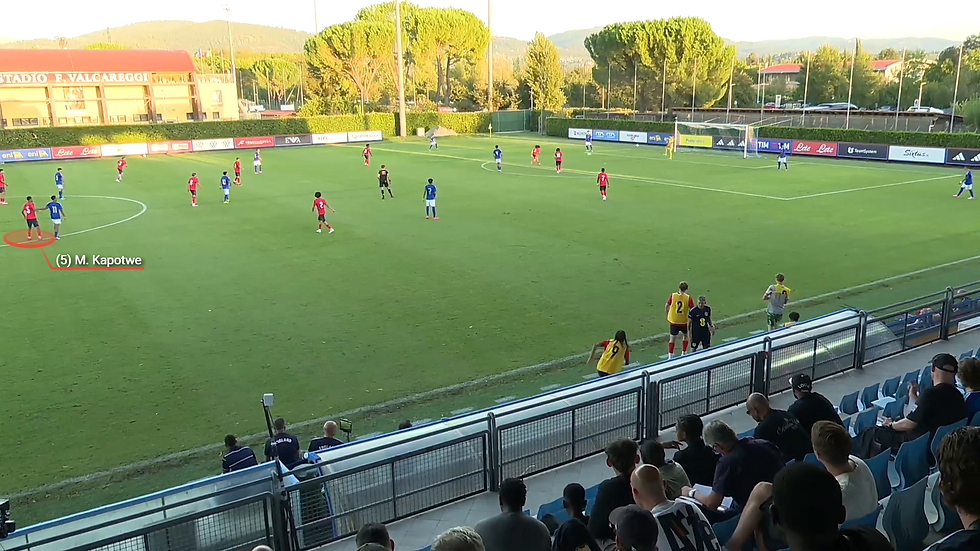
When it became clear that his centre-back partner #4 Wattley was going to advance, and therefore vacate his mark (Italy #9), to intercept the looping ball forward, Kapotwe dropped a couple of extra yards to the halfway line (first image), before beginning his sprint back towards his own goal when the ball ricocheted to Italy #9, creating a 2v1 attack (second image).
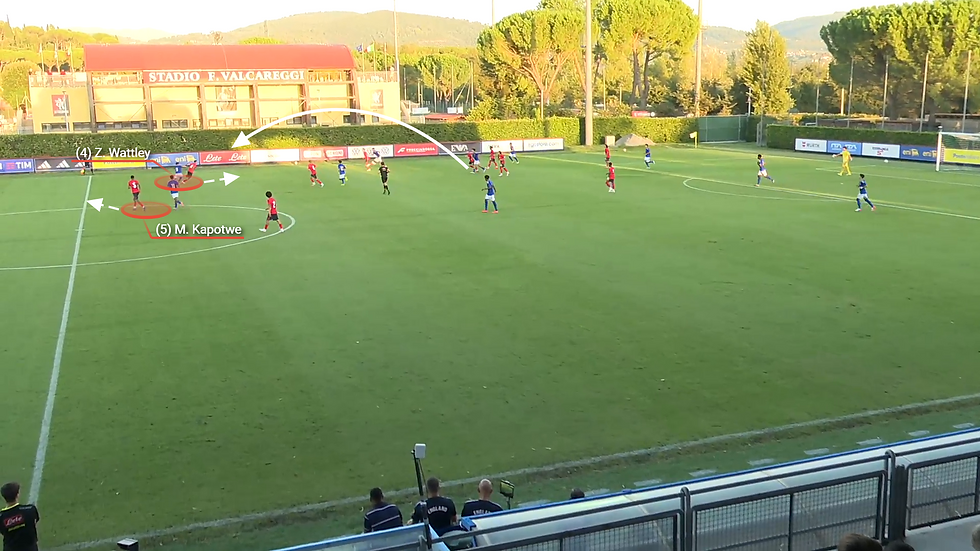
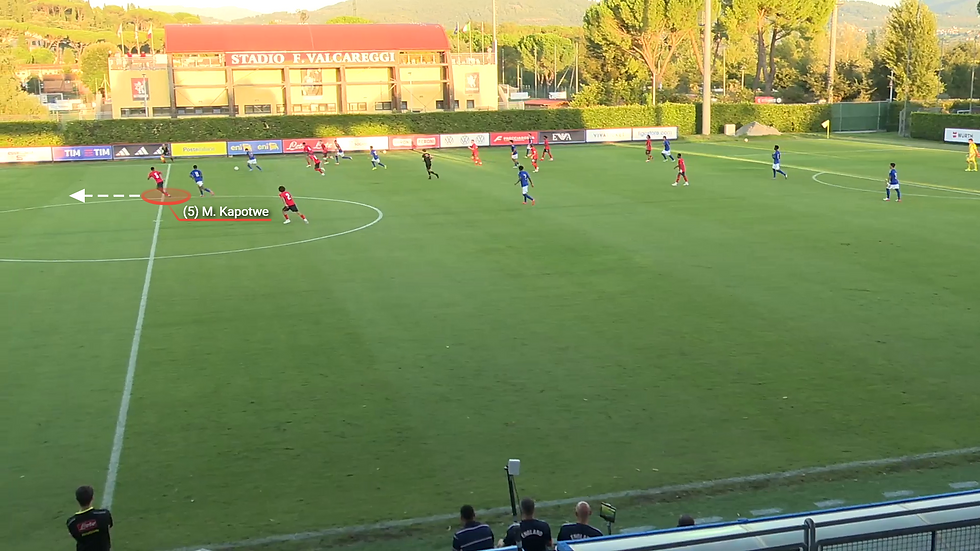
While travelling back towards his own goal, Kapotwe scanned for references to inform his decision-making process, importantly between the ball-carrier's touches. Firstly, checking over his left shoulder into his blindside, where he could see the running line of the Italy #11 and the position of the England RB, who was not in position to provide cover for the Italy #11.

Next, a look over his right shoulder towards the ball-side, where he could continue to monitor the direction of the ball carrier, see teammate #6 O’Keefe accelerating back (potentially quick enough to recover and apply pressure to the ball carrier), and check the supporting runs of other Italy attackers.

Then finally, one final glance over his left shoulder as the ball carrier reached the edge of the penalty area, to know the whereabouts of Italy #11 (ensure he was not going to dart in front towards the near post), before adjusting his body shape so he was on the half-turn and not facing his own goal (own-goal risk) and maintaining his recovery line inside the near post to block any low cross / pass attempt into #11 who would have had an open goal tap-in.
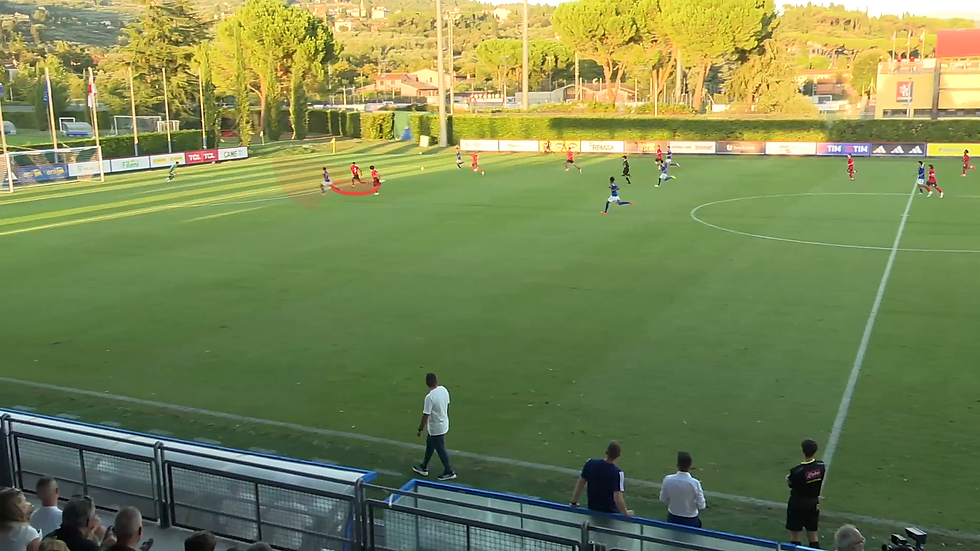
The Italy #9 opted to shoot from the acute angle forcing a save from the England goalkeeper, with #6 O’Keefe, who to his credit, recovered in time to at least provide interference to Italy #11 at the point of shooting, cleared the rebound.
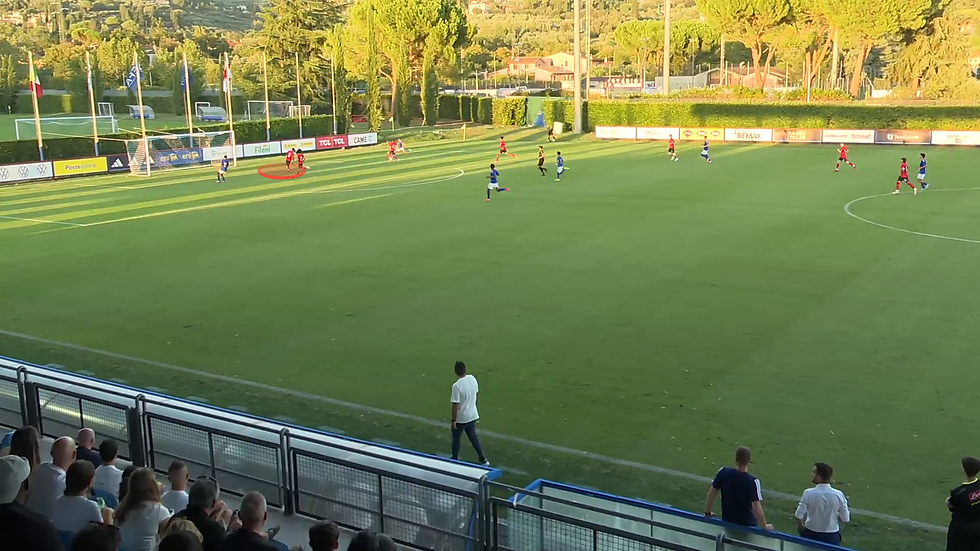
While only my interpretation, my take on this sequence was that Kapotwe, in the assessment of all these details: being the last defender, his RB being too advanced to provide cover, the wide position of the ball, the distance to the ball carrier, the distance to goal, the advanced and central position of Italy #11 - who would become free for a pass if Kapotwe engaged the ball, and teammate #6 O’Keefe potentially recovering to address the ball carrier, informed Kapotwe's decision to recover directly towards goal, in line with the near post, to block any direct pass across to Italy #11, as opposed to dropping diagonally and narrowing the distance between him and the ball.
The full Italy vs England U16s piece, which will include notes and observations from both fixtures, will be published in the coming weeks.
For reference, more focus was placed on the England team and players, and therefore the volume of notes for each side in these pieces will reflect this. Additionally, despite this being U16 level, I still aimed to understand how each team approached the game tactically, inferring what the collective intentions were in and out of possession, and across each phase, in order to better contextualise the individual player roles, actions and performances through that lens.
Furthermore, as per my 2026 UEFA European Under-17 Championship observations - where I watched and published notes on every game - I am interested in analysing the playing styles of different age groups within national associations to better understand how players and teams are being developed through their respective pathways, while continuing to develop my Talent ID baseline and benchmarking knowledge across different levels of the game.
Comments